
Studios rarely greenlight intelligent sci-fi without sanding it down first.
Edge of Tomorrow somehow slipped through.
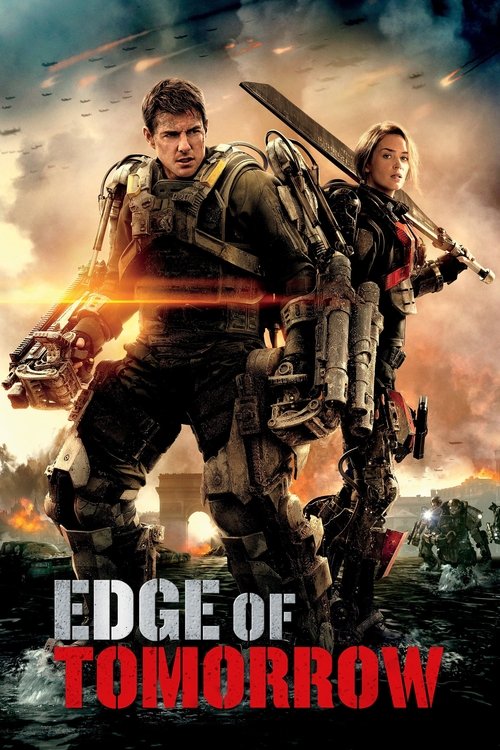
Directed by Doug Liman, this 2014 time-loop war thriller drops Tom Cruise into an alien invasion and forces him to die repeatedly until competence sets in. It sounds mechanical. It plays anything but.
It’s a blockbuster that respects structure. Already suspicious.
Tom Cruise, Repeatedly Corrected

Cruise plays Major William Cage, a smug military PR officer whose battlefield experience begins and ends with a press badge. Within minutes of landing on a Normandy-inspired beach assault, he’s killed. Then revived. Then killed again.
The film’s quiet genius is making Cruise — cinema’s most carefully curated action star — look panicked, unprepared, and deeply mortal. Cage evolves not through destiny, but iteration.
Every reset is humiliation.
Every death is data.
The performance leans into cowardice before earning heroism, which makes the transformation feel oddly satisfying.
Emily Blunt: The Upgrade

If Cruise is the variable, Emily Blunt is the fixed point. As Rita Vrataski — the battlefield legend who once had the same looping ability — Blunt is all focus and muscle memory.
She doesn’t soften the film. She sharpens it.
Their dynamic avoids romantic cliché for longer than expected. Trust is built through repetition, not chemistry alone. It’s practical. Almost clinical. Which suits the premise.
Structure as Weapon
Time-loop films often risk redundancy. Edge of Tomorrow treats repetition like a rhythm section — compressing montages, skipping steps once learned, escalating stakes with efficiency.
The beach invasion sequence remains one of the most controlled chaos set pieces of the 2010s. The alien “Mimics” are fast, violent, and abstract enough to remain unsettling without overstaying their visual welcome.
Importantly, the script knows when to stop repeating the joke.
Intelligence Without Self-Importance
What makes the film endure is its tonal balance. It’s funny without winking. Tactical without drowning in exposition. Spectacular without numbing you.
It doesn’t declare itself profound.
It just quietly outperforms expectations.
The Verdict
Edge of Tomorrow is a rare studio sci-fi that trusts its audience and tightens its premise instead of diluting it. It’s lean, clever, and unexpectedly disciplined.
Rating: 4.5 out of 5 reset alarms.
A reminder that sometimes the smartest blockbuster is the one that keeps trying — until it gets it right.
Leave a Reply