
Survival movies usually follow a predictable, agonizing rhythm. There is the crash. There is the realization that the cell service is non-existent (or, in 1997, that the flares are damp). There is the slow descent into madness, punctuated by the eating of a shoe. Usually, these films are about the triumph of the human spirit. They are about the will to live.
The Edge is not really about the human spirit. It’s about being smarter than the guy next to you while a 1,500-pound Kodiak bear tries to turn you into a buffet.
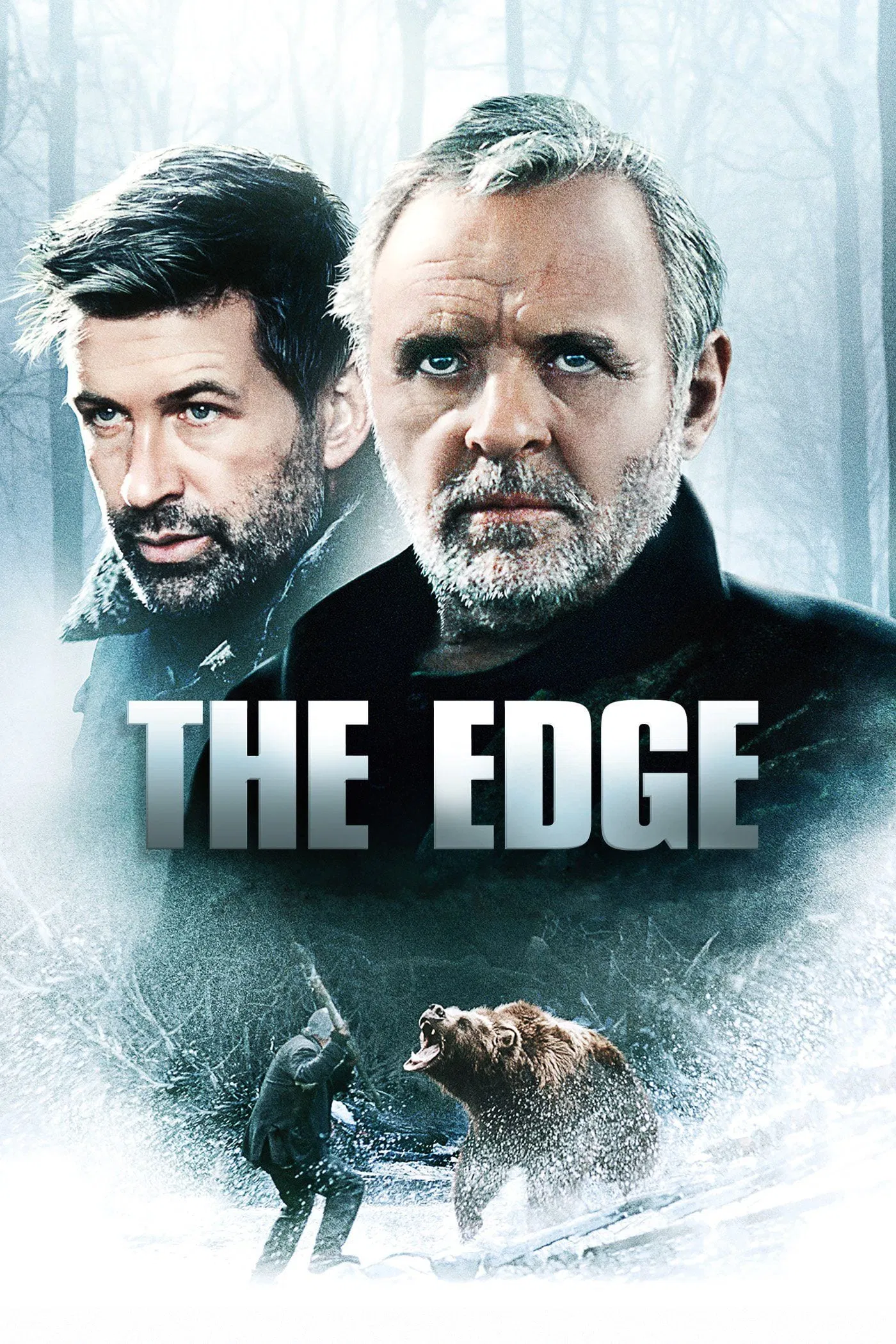
Directed by Lee Tamahori and written by the legendary David Mamet, The Edge is a wilderness thriller that trades sentimentality for cynicism. It’s a movie where the primary weapon isn’t a gun or a bow; it’s a book of trivia. It’s sleek. It’s urgent. It’s arguably the best film ever made about two men who hate each other but realize that being eaten by a bear is a poor career move for both of them.
The Billionaire and the Betrayal
The setup is classic Mamet. Charles Morse (Anthony Hopkins) is a billionaire with a photographic memory and a wife (Elle Macpherson) who is significantly younger than him. He is currently in Alaska for a photo shoot led by Bob Green (Alec Baldwin), a fashion photographer who exudes the kind of effortless, oily charm that Baldwin perfected before he became a professional parody of himself.
Charles is a man who knows everything because he has read everything. He is the guy who brings a book on “How to Survive in the Woods” to a luxury lodge. Everyone mocks him for it. Until, of course, their plane clips a flock of birds and plunges into a freezing lake, miles away from any hope of rescue.
Suddenly, Charles’s useless trivia, how to make a compass from a needle and a leaf, how to use a button to signal a plane, becomes the only currency that matters. But there’s a snag. Charles suspects that Bob is sleeping with his wife. Even worse, he suspects Bob is planning to kill him for the inheritance. It’s a survival movie. Yes, but it’s actually a high-stakes divorce proceeding with claws.
Mamet in the Mud

The screenplay is the secret sauce here. David Mamet is known for his staccato, rhythmic dialogue: the “Mamet Speak” that defined Glengarry Glen Ross. Usually, this kind of dialogue lives in smoke-filled rooms or gritty police stations. Putting it in the Alaskan wilderness is a stroke of genius. It strips away the outdoor-adventure fluff and turns every conversation into a chess match.
“What one man can do, another can do,” Charles repeats like a mantra. It’s a line that sounds like a motivational poster but, in the context of the film, feels like a threat.
The dialogue doesn’t waste time on platitudes about the beauty of nature. Nature, in Mamet’s world, is just another adversary to be outmaneuvered. The conflict between Charles and Bob is more dangerous than the cold. You can build a fire to beat the cold. You can’t build a fire to stop a man from sticking a knife in your back once you’ve led him back to civilization.
The Bear, the Myth, the Legend: Bart
We have to talk about the bear.

In the era of modern film reviews, we are used to CGI monsters that look like they were rendered on a toaster. In 1997, they used Bart the Bear. Bart was a real Kodiak who stood nine feet tall and weighed as much as a small car. When Bart is on screen, the fear in Hopkins’ and Baldwin’s eyes isn’t “acting.” It’s a biological imperative.
The bear in The Edge isn’t just a mindless beast. He is a stalker. He is a psychological pressure cooker. There is a sequence involving a bridge made of a fallen log that remains one of the most stressful five minutes in thriller movie history. The bear doesn’t just attack; he waits. He learns. He is the personification of the wilderness’s indifference to Charles’s billions.
One of the best movie reviews of the time noted that Bart managed to out-act most of the human cast. He’s majestic. He’s horrifying. He is the ultimate “fuck you” from Mother Nature.

Hopkins vs. Baldwin: A Masterclass in Friction
Anthony Hopkins is doing something very specific here. Long before the operatic solemnity of his later career, he was a master of the “still waters run deep” archetype. His Charles Morse is a man who has been underestimated his entire life because he is “just the money.” Watching him transition from a mild-mannered intellectual into a man who can sharpen a spear and scream at the sky is incredibly satisfying.
Alec Baldwin, meanwhile, plays the perfect foil. He is the physical specimen: the guy who looks like he should be the hero. But Bob is hollow. He’s a man of surface-level charms and deep-seated insecurities. The tension between the two is palpable. It’s a battle between the man who knows things and the man who wants things.

Their relationship is a masterclass in shifting power dynamics. At first, Bob is the leader because he is louder and stronger. By the midpoint, Charles has taken control because he is the only one who understands that “most people lost in the wild die of shame.” They die because they stop thinking. Charles never stops thinking.
Survival of the Most Cynical
What sets The Edge apart from other film reviews you might read about 90s thrillers is its lack of sentiment. There is no scene where the two men bond over their childhoods while staring at the stars. Every moment of cooperation is born of necessity, and every moment of rest is tainted by suspicion.
The cinematography by Donald McAlpine is stunning, capturing the vast, uncaring scale of the Canadian Rockies (standing in for Alaska). But the film never forgets that it is a thriller movie. It’s a slasher flick where the killer happens to be a bear and the final girl is a 60-year-old British billionaire.
It also tackles the theme of wealth in a way that feels surprisingly modern. Charles knows that his money makes him a target. He knows that his intelligence makes him an outsider. In the woods, his money is literally paper to start a fire. His intelligence, however, is the only thing that doesn’t burn.
The Verdict
The Edge is a rare beast (pun intended). It’s an intelligent action movie that doesn’t feel the need to explain itself to death. It trusts the audience to keep up with Charles’s logic and to feel the weight of Bob’s betrayal. It’s a movie that understands that the most dangerous thing in the woods isn’t the predator: it’s the person standing next to you.
If you’re looking for a survival thriller that provides more than just cheap jumps, this is it. It’s a film that asks: Who are you when the world is stripped away? Are you the guy who thinks, or are you the guy who dies of shame?
It’s sharp. It’s brutal. It’s Mamet with a grizzly. What more could you want?
Rating: 4.5 out of 5 Spears.
Leave a Reply