
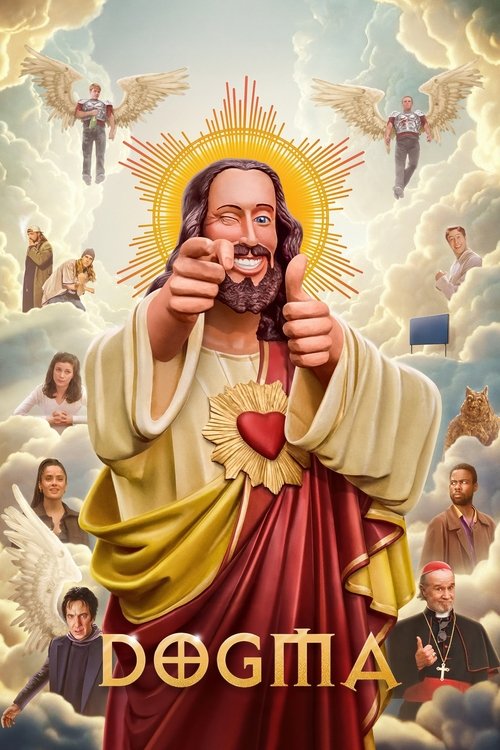
Religious epics usually follow a predictable trajectory. There are robes. There are booming voices from the heavens. There is, almost inevitably, Charlton Heston looking sternly at a piece of granite. Then there is Dogma.
Released in 1999, Kevin Smith’s fourth feature film arrived like a molotov cocktail wrapped in a Sunday school flyer. It replaced the burning bush with a rubberized Golgothan (a literal “Excremental Demon”) and swapped the Mount Sinai tablets for a plenary indulgence in Red Bank, New Jersey. It was a film that managed to offend almost everyone while being, at its core, deeply concerned with the mechanics of faith.
It is a film about the rules. Specifically, how the rules can break the universe if you follow them too literally.
The Loophole: A New Jersey Apocalypse
The premise is deceptively simple. Two fallen angels, Bartleby (Ben Affleck) and Loki (Matt Damon), have been exiled to Wisconsin for eternity: a fate Smith implies is worse than Hell itself. They discover a loophole. A cardinal in New Jersey (George Carlin, in inspired casting) is offering a “plenary indulgence” to anyone who passes through the arches of a specific cathedral. According to Catholic dogma, if they walk through those doors, their sins are scrubbed clean. They become pure. They can re-enter Heaven.

The catch? If they do this, they prove God is fallible. They override a divine decree. If God can be wrong, the foundation of existence collapses. Everything ceases to be. It’s a cosmic “blue screen of death” triggered by a clerical error.
Smith spends the better part of two hours dragging a motley crew: an abortion clinic worker (Linda Fiorentino), two prophets (Jay and Silent Bob), a forgotten thirteenth apostle (Chris Rock), and a Muse (Salma Hayek): across the tri-state area to stop them. But the ending is where the satire sharpens into something far more provocative than just “Jay and Silent Bob meet Jesus.”
The Hospital Scene: Unplugging the Divine
To understand the ending, you have to understand where God has been the whole time. Throughout the film, characters wonder why God hasn’t just stepped in and smote the wayward angels. The answer is found in a hospital bed.
Bethany (Fiorentino) discovers that God has a penchant for taking human form to enjoy the simpler things: like Skee-Ball on the Jersey Shore. While in this mortal “vessel,” God was attacked by the “Stygian Triplets” and left in a comatose state on life support. This is Smith’s ultimate gag: The Creator of the Universe is currently a “John Doe” in a coma, unable to vacate the body because doing so would release a divine energy that the human form (and the surrounding hospital) couldn’t contain.
The ending hinges on a paradox. Bethany, an abortion clinic worker who has spent the movie struggling with her own infertility and loss of faith, must commit an act of euthanasia. She has to unplug the respirator, killing the human vessel so that God can be liberated and return to her true form.
It’s an intentional, pointed bit of writing. Smith weaponizes the very doctrines his protesters were shouting about. He places the fate of existence in the hands of a woman who performs a job the Church condemns. To save the world, she must “end” a life. It’s a moment of heavy-handed irony that remains the film’s most intellectually sticky sequence.
The Church Front: Bartleby’s Descent
While Bethany is performing cosmic maintenance at the hospital, Bartleby has officially lost the plot. If Loki started the movie as the hot-headed executioner, he ends it as the voice of reason. He realizes that the cost of their “homecoming” is the erasure of everything. He wants to stop.

Bartleby, however, has transitioned from a disgruntled employee to a nihilistic revolutionary. He’s tired of being the middle manager of human suffering. He kills Loki: stripping him of his wings and his divinity: and stands before the church doors, ready to blink the universe out of existence.
This is the point where Dogma stops being a road trip comedy and starts being a tragedy about the burden of knowledge. Bartleby’s rage isn’t just directed at God; it’s directed at the unfairness of the divine hierarchy. He’s the first angel to experience “human” emotions like spite and jealousy, and he handles them about as well as a teenager with a social media account.
The Arrival: Enter Alanis Morissette
Then comes the “Ending Explained” moment that fueled a thousand 1990s message board debates. God arrives. And God is Alanis Morissette.

It’s easy to dismiss this as a “90s-era stunt casting” choice, but it serves a specific narrative purpose. When God finally manifests outside the church, she doesn’t use words. Why would she? As Metatron (Alan Rickman) explains earlier in the film, the human ear can’t handle the actual voice of God. It would literally blow your head off.
Bartleby, fueled by righteous indignation, demands an answer. He wants a justification for his exile. God gives him one, but not in the way he expects. She lets out a sonic boom of a “shout”: a divine vibration: that doesn’t just silence Bartleby; it uncreates him. It is the ultimate “Because I said so.”
In this moment, Smith suggests that the search for “meaning” or “logic” in religious dogma is a fool’s errand. You don’t argue with the person who invented the concept of an argument. You just… cease to be.
The Scion: Life After the Apocalypse
The final beats of the film are surprisingly tender for a movie that features a man being beaten to death with a hockey stick.
Bethany is dead, having sacrificed herself at the hospital. But God, now back in the driver’s seat, isn’t done. She resurrects Bethany and reveals the “Truth” with a capital T. Bethany, who thought she was a barren failure, is now pregnant. She is carrying the next “Scion”: the continuation of the bloodline of Jesus.
This is where the “Truth” of Dogma lies. The ending isn’t about the loophole. It’s about the shift from dogma (the rigid, unbending rules of the Church) to faith (the living, breathing, and often messy reality of belief). By impregnating the “last” descendant of Christ, God ensures that the story doesn’t end. The rules were proven to be dangerous, but the spark of life is the “workaround.”
Why It Still Matters (And Why It’s Still Missing)
If you look for Dogma on streaming services today, you won’t find it. It’s a digital ghost. Due to a complicated rights issue involving the Weinsteins, the film hasn’t been officially re-released in years. You can’t rent it on Amazon. You can’t find it on Netflix. It exists only on dusty DVDs and the occasional “unofficial” YouTube upload.
In a way, that’s a fitting fate for the movie. Dogma was always an outlier. It’s a film that argues God has a sense of humor, yet it was picketed by people who clearly didn’t. It’s a film that uses profanity to discuss the sacred.
The ending works because it refuses to be a lecture. It doesn’t provide a list of “Correct Beliefs.” Instead, it suggests that God is a woman who likes Skee-Ball, hates being told what to do, and values the survival of the human race over the strict adherence to a guidebook written in New Jersey.
It’s witty. It’s messy. It’s unapologetically weird. Much like the state of New Jersey itself.
For more deep dives into the films that defined (and occasionally broke) the late 90s, keep it locked here. We’re dissecting the classics, the cult favorites, and everything in between.
Explore more of our movie reviews and analysis of cinema’s most confusing finales.
Tags: #Dogma #KevinSmith #EndingExplained #MovieReviews #FilmReviews #90sCinema #ReligiousSatire #ELFILMCRITIC
Leave a Reply