
Thrillers usually demand a specific set of ingredients to keep the pulse elevated: a high-speed pursuit, a ticking clock, or at the very least, a protagonist who knows how to handle a firearm. Usually, the stakes are measured in body counts or international espionage. All the President’s Men (1976) decides to trade the Glock for a Smith-Corona typewriter and the car chases for a series of increasingly frustrating long-distance phone calls. It’s a film about the most tedious aspects of professional labor: note-taking, directory-browsing, and door-knocking: that somehow manages to be more terrifying than most slasher flicks.
It’s sleek. It’s urgent. It’s a movie where the primary weapon of choice is a yellow legal pad.
Directed by Alan J. Pakula: coming off the heels of the equally paranoid The Parallax View: this is the definitive document of the Watergate scandal. But calling it a “historical drama” feels like an insult to its pacing. It is a procedural in the purest sense, stripping away the melodrama to focus on the grit of the grind. In a world where “fake news” is a convenient rhetorical shield for anyone with a bruised ego, revisiting the film that codified the “gold standard” of investigative journalism feels less like a nostalgia trip and more like a necessary reality check.
The Newsroom: A White-Collar Trenches
The film opens with a break-in at the Democratic National Committee headquarters that looks remarkably pathetic. There are no laser grids or acrobatic heists; just five men in bad suits fumbling with flashlights.

From there, we are dropped into the bustling, fluorescent-lit purgatory of The Washington Post.
Pakula and his legendary cinematographer, Gordon Willis (often called “The Prince of Darkness” for his work on The Godfather), create a visual dichotomy that defines the film’s tension. The newsroom is an overexposed, sterile white void. It is the place where facts are processed under the unforgiving glare of accountability. Contrast this with the world outside: the shadowy parking garages, the late-night streets, and the wood-paneled offices where the truth goes to hide.

The production design famously involved spending nearly half a million dollars to recreate the Post’s newsroom down to the last stray pencil and discarded coffee cup. It shows. There is a weight to the setting that most modern movie reviews struggle to find in today’s CGI-laden landscape. The newsroom isn’t just a backdrop; it’s a character that demands a specific rhythm of speech and movement.
Redford and Hoffman: The Friction of Fact-Finding
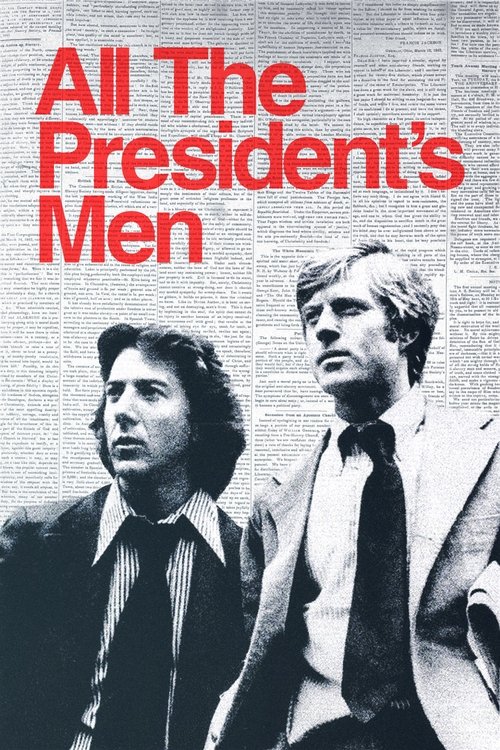
The film lives and dies on the chemistry: or lack thereof: between its leads. Robert Redford (Bob Woodward) and Dustin Hoffman (Carl Bernstein) were, at the time, at the absolute zenith of their movie-star powers. But they don’t play Woodward and Bernstein as heroes. They play them as hungry, slightly desperate, and occasionally annoying professionals.
Redford’s Woodward is the buttoned-down, WASP-y Republican with a nose for the “official” story. He’s the one who gets the foot in the door. Hoffman’s Bernstein is the scruffy, chain-smoking, counter-culture intellectual who knows how to massage a source until they leak. They don’t necessarily like each other at first. There is no “buddy cop” montage where they share a beer and talk about their fathers. Their bond is forged entirely through the shared realization that they are pulling on a thread that might unravel the entire Executive Branch.
The performances are masterclasses in understated technicality. Watch the way they handle phones. In 1976, journalism was an athletic event involving rotary dials and tangled cords. They balance handsets on their shoulders, scribble frantically with leaking pens, and repeat names with a rhythmic persistence that borders on the hypnotic. It is a very specific type of screen acting that values the “process” over the “moment.”

The Pacing: The Beauty of the Repetitive Loop
Roger Ebert famously noted that the film’s structure is repetitive: that once you’ve seen one cycle of investigative reporting, the rest follow a predictable pattern. He wasn’t wrong. Woodward and Bernstein hit dead ends. They get lied to. They get doors slammed in their faces. Then they go back to the newsroom, get yelled at by their editor (a magnificent, grumbling Jason Robards as Ben Bradlee), and do it all over again.
However, where Ebert saw a potential for redundancy, Pakula finds a source of mounting dread. The repetition is the point. All the President’s Men isn’t about the “Aha!” moment; it’s about the cumulative weight of small, verified details. It’s about the fact that the truth isn’t found in a single smoking gun, but in the slow, agonizing process of eliminating lies.
The pacing is deliberate. It’s a slow-burn that refuses to accelerate even when the stakes become existential. When Woodward meets his mysterious source, “Deep Throat” (Hal Holbrook), in the shadows of a parking garage, the tension isn’t built through threat of violence. It’s built through the whispered confirmation of things Woodward already suspects. Holbrook’s delivery: weary, cryptic, and genuinely frightened: anchors the film’s central thesis: “Follow the money.”

Why It Remains the Gold Standard
Every journalism movie made since 1976: from Spotlight to The Post: is working in the shadow of this film. They are all, to some degree, trying to recapture the specific alchemy of Pakula’s vision.
What separates All the President’s Men from its descendants is its refusal to be sentimental. There are no sweeping speeches about the “freedom of the press” delivered to a stirring orchestral swell. There are no scenes of the reporters’ families worrying about them at home. (Actually, we learn almost nothing about their personal lives, which is a refreshing bit of narrative restraint).
The film understands that the work is the story. It treats journalism as a craft, not a calling. By focusing on the minutiae: the “non-denial denials” issued by the White House, the frantic cross-referencing of library slips: it makes the eventual victory feel earned rather than inevitable.
In our current era of instant gratification and 280-character hot takes, the film’s insistence on “slow” news feels radical. It reminds us that the best film reviews and the best journalism both require the same thing: time, skepticism, and a refusal to take the first answer as the final one.
The Prince of Darkness and the Shadows of Power
We have to talk about the lighting. Gordon Willis’s work here is nothing short of revolutionary. In the 70s, “thrillers” were often gritty and handheld. Pakula and Willis went the other way. They used deep focus and wide shots to show how small Woodward and Bernstein were in the face of the institutions they were challenging.
There is a famous overhead shot in the Library of Congress where the camera pulls back, further and further, until our two leads are just two tiny specks at a desk, surrounded by concentric circles of books and records. It’s a visual metaphor for the sheer scale of the information they are trying to digest. It’s beautiful, it’s cold, and it’s deeply intimidating.
A Legacy of Paranoia
All the President’s Men was released just two years after Nixon resigned. To the audiences of 1976, this wasn’t ancient history; it was a fresh wound. The film captures that specific mid-70s malaise: the feeling that the people in charge are not just incompetent, but actively malicious.
It avoids the trap of being a hagiography. It doesn’t treat the Washington Post as an infallible fortress of truth. We see the mistakes. We see the moments where Woodward and Bernstein almost blow the story because of their own hubris or lack of experience. We see the internal politics of the paper, the skepticism of the older editors, and the very real fear that they might be destroying the publication’s reputation.
It is an intriguing idea: a movie about a massive political victory that feels, for most of its runtime, like a crushing defeat. Execution is another matter, and Pakula nails it by keeping the camera close to the frustration.
The Final Teletype
The film ends not with a courtroom scene or a dramatic arrest, but with a teletype machine. We see the news of Nixon’s second inauguration playing on a television in the background: a sea of cheering crowds and patriotic music: while in the foreground, Woodward and Bernstein are back at their desks, typing.
Then, the camera focuses on the teletype. We see the headlines flash across the screen as the machine clatters away. Nixon resigns. Ford takes the oath. The story is over, but the work continues. It’s a chillingly quiet ending for a film about a historical earthquake. It suggests that while the names at the top might change, the machine: and the need for people to watch it: is permanent.
As far as best movie reviews go, the consensus hasn’t shifted much in fifty years: All the President’s Men remains the definitive cinematic argument for the necessity of the “boring” parts of democracy. It’s not about the glory; it’s about the notes.
It’s sleek. It’s urgent. And it’s still the one to beat.
Leave a Reply