
Roland Emmerich doesn’t believe in small weather.
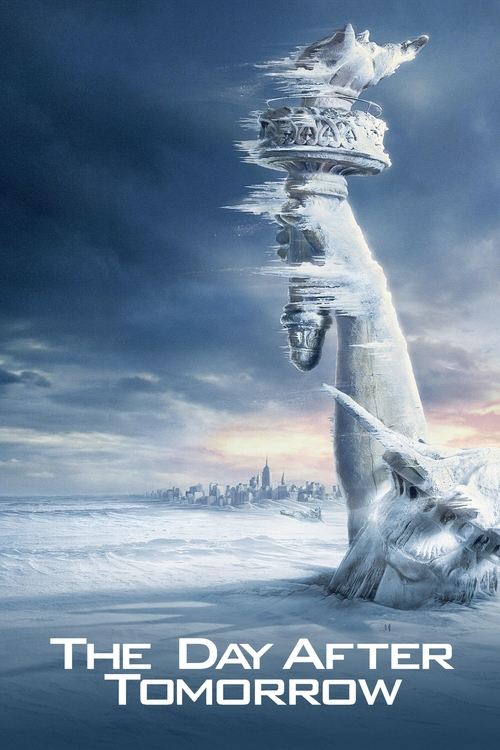
Directed by Roland Emmerich (Independence Day, 2012), The Day After Tomorrow takes climate change anxiety and accelerates it to blockbuster velocity. Subtle environmental shifts? No thank you. Emmerich prefers tidal waves swallowing Manhattan, helicopters freezing midair, and an Ice Age arriving with the punctuality of a studio release date.
The science is elastic. The spectacle is not.
Disaster as Escalation

The premise hinges on abrupt climate collapse triggered by disrupted ocean currents. Within days, the Northern Hemisphere spirals into apocalyptic winter. It’s less a gradual warming crisis than a meteorological tantrum.
Emmerich has always favored immediacy over plausibility. In Independence Day, aliens detonated landmarks; here, nature does the honors. The iconic sequence of a tsunami crashing through New York remains one of early-2000s CGI’s defining images—operatic, excessive, undeniably gripping.
You may question the thermodynamics. You won’t question the ambition.
Dennis Quaid vs. The Atmosphere
Dennis Quaid plays paleoclimatologist Jack Hall, a scientist who realizes—slightly too late—that his warnings were accurate. Quaid delivers the role with straight-faced urgency, grounding the absurdity with professional conviction.

His cross-country trek through subzero conditions to rescue his stranded son is framed as heroic paternal endurance. It’s ridiculous. It’s earnest. It works because the film never smirks at itself.
Emmerich’s sincerity is his secret weapon.
Jake Gyllenhaal in the Frozen Library
Jake Gyllenhaal, pre-Brokeback Mountain and years before indie gravitas became his signature, plays Sam Hall, trapped in a New York Public Library as temperatures plummet. The library sequences—survivors burning books for warmth—offer the film’s most contained tension.

For a brief stretch, The Day After Tomorrow resembles a survival thriller rather than CGI showcase. It’s here the film finds unexpected focus. Character dynamics matter. Stakes feel immediate.
Then another storm system rolls in.
Politics, Simplified
Like much of Emmerich’s filmography, geopolitics are streamlined into digestible morality. The U.S. initially ignores environmental warnings. Nature responds decisively. There’s a pointed, if broad, message about global responsibility and scientific denial.
It’s not nuanced commentary. It’s disaster as cautionary billboard.
But in 2004, that earnestness felt almost novel in a summer blockbuster.
The Physics Problem
Does the film compress decades of climate science into a weekend snowstorm? Absolutely. Do characters outrun temperature drops that defy atmospheric logic? Repeatedly.
Yet Emmerich’s conviction carries the narrative past scrutiny. He doesn’t dabble in metaphor. He floods it.
If you accept the premise—and that’s a choice—you’re rewarded with sustained spectacle and genuine tension.
The Verdict
The Day After Tomorrow is scientifically adventurous, narratively blunt, and visually committed to annihilation. It’s disaster cinema operating at full melodramatic throttle.
And somehow, despite the implausibility, it’s consistently watchable.
Rating: 3.5 out of 5 frozen skylines.
Absurd? Frequently.
Earnest? Entirely.
Entertaining? More than it probably should be.
Leave a Reply