
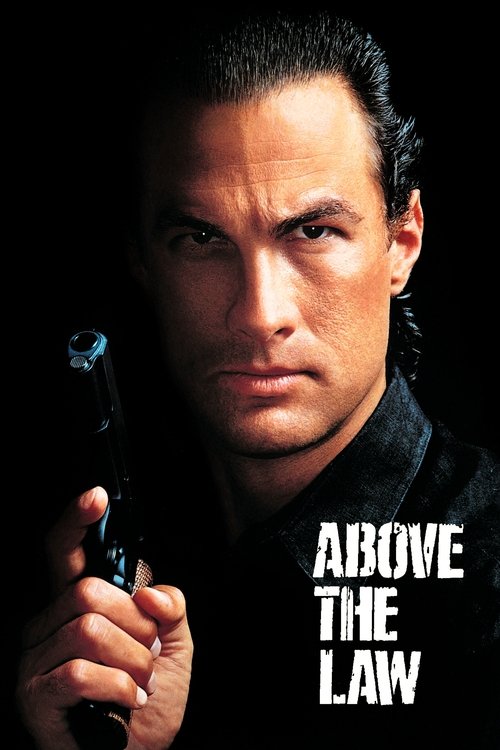
Before he was running awkwardly through direct-to-video purgatory, Steven Seagal arrived fully formed: whisper-voiced, spiritually intense, and violently efficient. Above the Law doesn’t introduce a movie star so much as unveil a brand—part aikido exhibition, part political thriller, part hair commercial.
Directed by Andrew Davis, the film positions Seagal as Nico Toscani, a Chicago cop with CIA history, martial arts mastery, and a near-religious devotion to punching corruption in the throat. It’s late-’80s action cinema on the cusp of self-parody—deadly serious and accidentally funny.
It believes in conspiracy. It believes in bone-snapping. It especially believes in Nico.
Nico Toscani: Enlightenment Through Elbows

Seagal’s screen presence is less performance, more posture. He doesn’t so much act as loom. Dialogue is delivered in a low murmur that suggests either profound wisdom or mild inconvenience. When conflict arises, however, the murmuring stops and limbs begin rearranging themselves at unnatural angles.
The fight choreography—built around Seagal’s aikido background—is the film’s primary selling point. Arms are twisted. Wrists are folded. Assailants are flipped with casual disdain. There’s an almost instructional quality to it, as though Nico might pause mid-brawl to explain joint leverage.
Charisma is debatable. Efficiency is not.
Conspiracy as Set Dressing
The plot, involving rogue CIA operatives and covert operations, aspires to political heft. It gestures toward government misconduct and Cold War paranoia, but never quite commits to depth. The conspiracy exists mainly to justify more hallway beatdowns.
That said, there’s a scrappy sincerity to the storytelling. This isn’t glossy ’90s excess; it’s gritty Chicago streets, fluorescent-lit police stations, and villains who sweat under pressure—sometimes because their elbows are being hyperextended.
The Standout Sequence: The Barroom Clinic
One early bar fight functions as thesis statement. A handful of antagonists make the mistake of underestimating the ponytail. What follows is a crisp demonstration of Seagal’s physical vocabulary—fluid redirection, minimal wasted motion, maximum orthopedic regret.
It’s efficient. It’s brutal. It’s oddly polite in its precision. And it tells you exactly what kind of movie you’re watching.
Cultural Context: The Birth of a Particular Era
Above the Law helped launch Seagal into a brief but potent run of late-’80s and early-’90s action vehicles. It’s not as iconic as Die Hard nor as bombastic as the Schwarzenegger-Stallone arms race, but it carved out its own niche: stoic mysticism meets municipal violence.
In hindsight, the film feels like the blueprint for a persona that would calcify quickly. Here, at least, the novelty still has a pulse. The self-seriousness hasn’t yet tipped into self-caricature. The ponytail remains undefeated.
The Verdict
Above the Law is lean, functional, and unintentionally amusing in its unwavering belief that spiritual calm pairs naturally with joint dislocation. It’s not top-tier ’80s action, but it’s a fascinating origin story for one of the genre’s most singular figures.
Efficient. Earnest. Slightly absurd.
Rating: 2.5 out of 5 snapped wrists.
Leave a Reply