
By 2013, the Marvel formula was no longer experimental—it was doctrine. The Avengers had assembled, the box office had been conquered, and the suits were shinier than ever. The expectation? Bigger spectacle. Louder villains. More sky-beams, presumably.
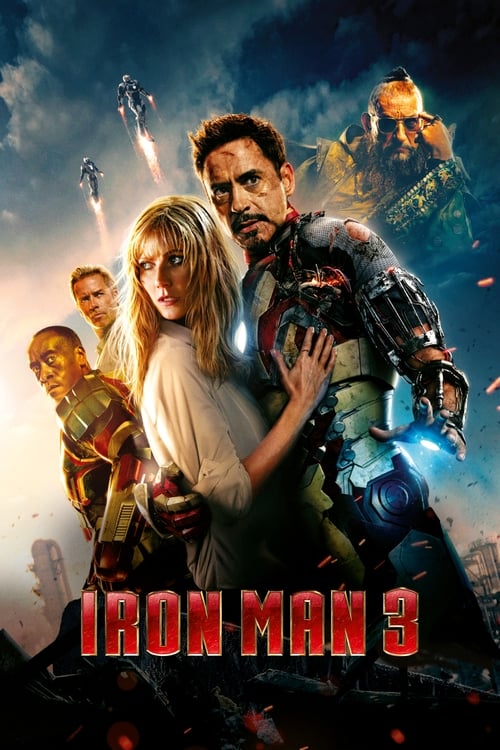
Instead, Iron Man 3 does something quietly radical: it strands its hero without his armor and asks him who he is without it.
Directed by Shane Black—patron saint of Christmas-set action movies and sharp-tongued buddy comedies—the film pivots inward. This isn’t about saving the world. It’s about surviving anxiety. Not technological evolution. Psychological reckoning.
A Hero in Pieces
Robert Downey Jr. plays Tony Stark as a man unraveling. Post–Battle of New York, he’s sleepless, obsessive, building suits as if they’re emotional barricades. The swagger remains, but it’s cracked by panic attacks and compulsive tinkering. Downey leans into vulnerability without sacrificing rhythm; his performance is jittery, funny, and unexpectedly tender.

The ensemble adjusts accordingly. Gwyneth Paltrow’s Pepper becomes the emotional anchor, her patience stretched thin but never saintly. The film wisely gives her agency rather than relegating her to endangered motivation.

Meanwhile, Ben Kingsley delivers one of the MCU’s most audacious curveballs as the Mandarin—a performance that begins in operatic menace and mutates into something far more satirical. It’s a twist that divided audiences but perfectly suits Black’s sensibilities.

Even Guy Pearce’s Aldrich Killian, while more functional than iconic, operates as a dark mirror: a man shaped by neglect and ego, weaponizing both. The character dynamics revolve less around domination and more around identity—who gets to define themselves, and who gets rewritten by trauma.
Anxiety, Identity, and the Illusion of Power
The film’s central thesis is elegantly simple: Tony Stark is not the suit. The suit is a coping mechanism. In stripping him of reliable technology for much of the runtime, the narrative exposes the fragility beneath the bravado. The villainy of Extremis—unstable bodies weaponized by ambition—mirrors Stark’s own internal volatility.
There’s also a sly commentary on media manipulation and performative terrorism. The Mandarin myth operates as spectacle—fear packaged for consumption. The film skewers the aesthetics of menace while exploring the psychology of it. For a blockbuster, it’s surprisingly introspective.
Controlled Chaos, Shane Black Style
Black’s direction favors character-driven action over bombast. The Tennessee sequences play almost like a neo-noir detour, complete with snow, small-town eccentricity, and dry humor. The climactic “House Party Protocol” unleashes a dazzling ballet of autonomous suits, yet the emotional focus never drifts far from Tony’s internal collapse.
Visually, the film is sleeker and brighter than its predecessors, trading industrial grit for clean digital spectacle. The action choreography is crisp, the comedic timing precise. It feels confident enough to bend the formula without breaking it.
Where It Lingers
The third act, for all its fireworks, edges toward excess. Killian lacks the psychological weight the Mandarin initially promises, and the Extremis concept never feels as thematically sharp as it could. The emotional resolution—Tony’s symbolic purge of the suits—lands cleanly, though subsequent franchise entries inevitably dilute its finality.
Still, the film’s risks outweigh its conveniences.
The Verdict
Iron Man 3 is less interested in escalation than excavation. It peers beneath the armor and finds something jittery, wounded, and defiantly human.
It’s a superhero film about panic attacks.
And somehow, that works.
Rating: 4 out of 5 dismantled arc reactors.
Leave a Reply