
Rating: 4 out of 5 off-key lullabies
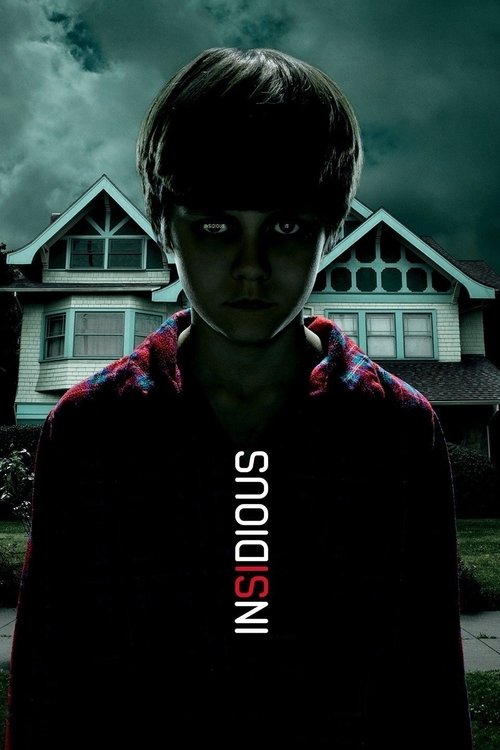
Most haunted house films begin with geography. A family moves into a new home. The home is wrong. The walls hold secrets. Insidious, directed by James Wan (who previously reinvented low-budget horror with Saw and would later refine supernatural tension in The Conjuring), begins by removing the house entirely as the problem. The threat is not attached to a structure. It is attached to a person.
This distinction is not cosmetic. It is existential.

Josh and Renai Lambert (Patrick Wilson and Rose Byrne) are not presented as reckless or dysfunctional parents. They are competent, attentive, and plausibly human. Their son Dalton (Ty Simpkins) falls into an unexplained coma after a minor household accident—an event that initially registers as tragic but medically containable. Doctors provide clinical language. Machines provide artificial reassurance. Nothing supernatural has been confirmed. Yet.
Wan’s direction operates on delayed confirmation. He does not begin with spectacle. He begins with spatial discomfort. The camera lingers in empty rooms half a second too long. Sounds occur without visible origin. Movement happens at the edge of perception, where certainty becomes optional.
This is not a film interested in jump scares alone. It is interested in destabilization.
Patrick Wilson’s performance as Josh is deliberately restrained. Wilson, who would later become a central figure in Wan’s Conjuring universe as Ed Warren, plays Josh as emotionally distant, but not maliciously so. His detachment reads less like indifference and more like avoidance. He senses something is wrong before he allows himself to articulate it.
Rose Byrne provides the film’s emotional grounding. Renai does not question her perceptions. She responds to them. Byrne avoids theatrical hysteria, instead portraying fear as accumulation—a series of small, unignorable confirmations that reality is no longer operating under its previous rules.
The film’s structural pivot arrives with the introduction of Elise Rainier (Lin Shaye), a paranormal investigator whose calm authority reframes the narrative. Elise does not present herself as speculative. She presents herself as procedural. The supernatural, in her presence, becomes operational rather than mysterious.
Lin Shaye’s performance is the film’s most quietly transformative element. Elise is not eccentric for comedic relief. She is professional. Her certainty removes ambiguity. The threat becomes diagnosable.
What follows is the film’s most important conceptual shift: Dalton is not being haunted. He has traveled. His consciousness has entered a dimension known as “The Further”—a liminal space where abandoned spirits persist in suspended hostility. This is not possession in the traditional sense. It is displacement.

Wan visualizes The Further with deliberate theatrical artificiality. Unlike the grounded domestic realism of the Lambert home, this realm feels constructed—fog, shadow, and negative space arranged with unnatural precision. The environments resemble memory more than location. They feel incomplete.
The film’s most iconic figure—the red-faced entity later colloquially nicknamed the “Lipstick-Face Demon”—appears sparingly. Wan understands a fundamental horror principle: frequency reduces effectiveness. The entity is not frightening because of what it does. It is frightening because of how rarely it appears and how confidently it occupies space when it does.
Composer Joseph Bishara’s score reinforces this instability. Rather than relying on melodic continuity, the sound design employs dissonance—violin screeches, tonal disruptions, and abrupt sonic absence. Silence, here, is not relief. It is anticipation.
What distinguishes Insidious from many of its contemporaries is its emphasis on inherited vulnerability. Josh’s emotional distance is eventually revealed not as personality, but as suppression. He has experienced The Further before. He has survived it. He has spent his adult life refusing to acknowledge it.
This reframes the haunting as cyclical rather than accidental.
Released in 2010 on a modest budget of approximately $1.5 million, Insidious became a commercial success, grossing over $99 million worldwide. This financial disparity illustrates a recurring pattern in horror cinema: conceptual precision consistently outperforms production scale. Fear does not require expensive imagery. It requires structural patience.
Wan’s direction demonstrates an advanced understanding of escalation. The film does not attempt to overwhelm the viewer continuously. It alternates between normalcy and intrusion, allowing the audience to briefly recover before destabilizing them again.
By the final act, the film abandons the illusion of safety entirely. Josh enters The Further himself—not as an observer, but as a participant. The environment does not behave like physical reality. Time does not behave like time. The familiar becomes navigationally hostile.
The film concludes not with restoration, but with contamination. The boundary between worlds has been crossed. Permanently.
Insidious is not about ghosts as external invaders. It is about ghosts as residents. They do not arrive. They wait.
And sometimes, they inherit you.
Leave a Reply