
Rating: 3.5 out of 5 stolen reservation names
Marriage, according to most films, ends in one of two ways: quiet contentment or explosive collapse. Date Night proposes a third option—weaponized inconvenience. Directed by Shawn Levy (who would later refine his mainstream comedic precision with Free Guy and Deadpool & Wolverine), this 2010 comedy operates on a simple but durable premise: what if the greatest threat to your marriage was not boredom, but efficiency?
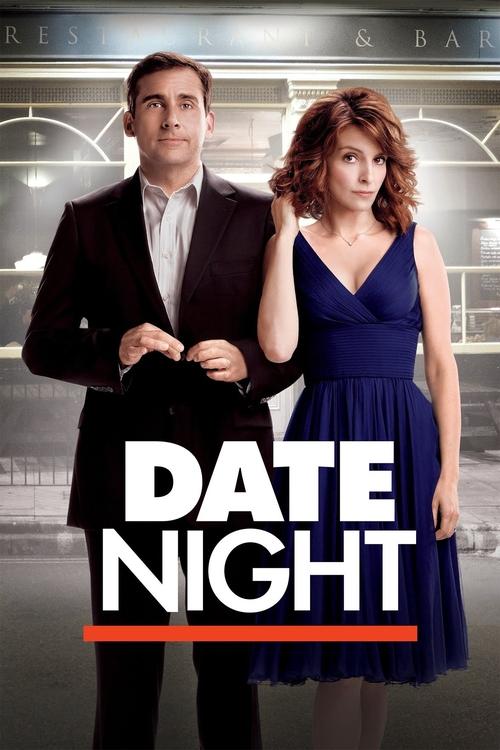
Phil and Claire Foster (Steve Carell and Tina Fey) are not unhappy. They are worse: they are settled. They live in suburban New Jersey, raise two children, maintain respectable careers, and communicate almost exclusively through logistics. Their conversations are dominated by calendars, school obligations, and low-stakes domestic negotiations. They function perfectly. They feel nothing.
Carell and Fey, both emerging from defining television runs—The Office and 30 Rock, respectively—bring a lived-in familiarity to their roles. They understand the rhythms of people who have been together long enough to stop performing for each other. Their chemistry is not based on seduction. It is based on recognition.

The inciting incident arrives through administrative fraud. Unable to secure a last-minute reservation at an upscale Manhattan restaurant, Phil impulsively claims another couple’s booking. This small act of suburban rebellion triggers a cascading series of increasingly disproportionate consequences involving corrupt police officers, organized crime figures, and individuals with professional-grade firearms who are deeply committed to resolving the situation incorrectly.
This escalation is the film’s primary structural engine. Ordinary people, placed inside an extraordinary threat environment, respond not with competence, but with approximation. Phil and Claire do not become action heroes. They remain amateurs. Their survival depends less on skill than on persistence and mild panic.
What distinguishes Date Night from similar action-comedies is its emphasis on relational repair rather than external victory. The chaos functions as forced intimacy. Phil and Claire are required, for the first time in years, to observe each other under pressure. They rediscover not who they were, but who they still are beneath routine.

Carell’s performance is built on fragile confidence. Phil believes himself capable of decisive action, but his decisiveness consistently arrives two seconds late. Fey, meanwhile, grounds Claire with pragmatic awareness. She understands the absurdity of their situation immediately. She simply lacks a mechanism to exit it.
Their dynamic becomes the film’s emotional ballast.
The supporting cast operates with deliberate efficiency. Mark Wahlberg, appearing as a shirtless private security contractor, functions less as a character and more as a visual disruption—an embodiment of physical confidence that contrasts sharply with Phil’s improvisational masculinity. James Franco and Mila Kunis, as the criminals whose identities Phil and Claire accidentally assume, radiate a calm detachment that makes them more unsettling than overtly violent antagonists.

Levy directs with clean, functional pacing. The film moves quickly, rarely pausing long enough to question its own plausibility. This is intentional. Date Night is not interested in realism. It is interested in momentum.
Cinematically, New York City is presented not as a romantic landscape, but as an operational maze. Restaurants, alleyways, offices, and highways become transitional environments rather than destinations. The city is not a character. It is an obstacle course.
The film’s humor emerges from behavioral accuracy rather than constructed jokes. Much of its comedy depends on recognition—the small humiliations of adulthood, the quiet negotiations of long-term relationships, the realization that excitement often arrives disguised as inconvenience.
What gives Date Night its unexpected durability is its refusal to resolve the marriage through grand revelation. Phil and Claire do not fundamentally change. They remember. They remember why they chose each other before routine converted their relationship into infrastructure.
By the film’s conclusion, the threat has passed, but its emotional function remains intact. The night did not transform them into different people. It reminded them they were never as static as they believed.
Released in 2010, during a period when mid-budget studio comedies still prioritized character-driven humor over spectacle dependency, Date Night represents a transitional artifact. It balances traditional comedic structure with action-driven escalation, anticipating the hybrid genre formulas that would dominate the following decade.
In the end, Date Night argues that relationships do not decay because of conflict. They decay because of predictability. Crisis, paradoxically, becomes restorative—not because it is pleasant, but because it is clarifying.
The greatest threat to long-term stability is not danger.
It is repetition.
Leave a Reply